
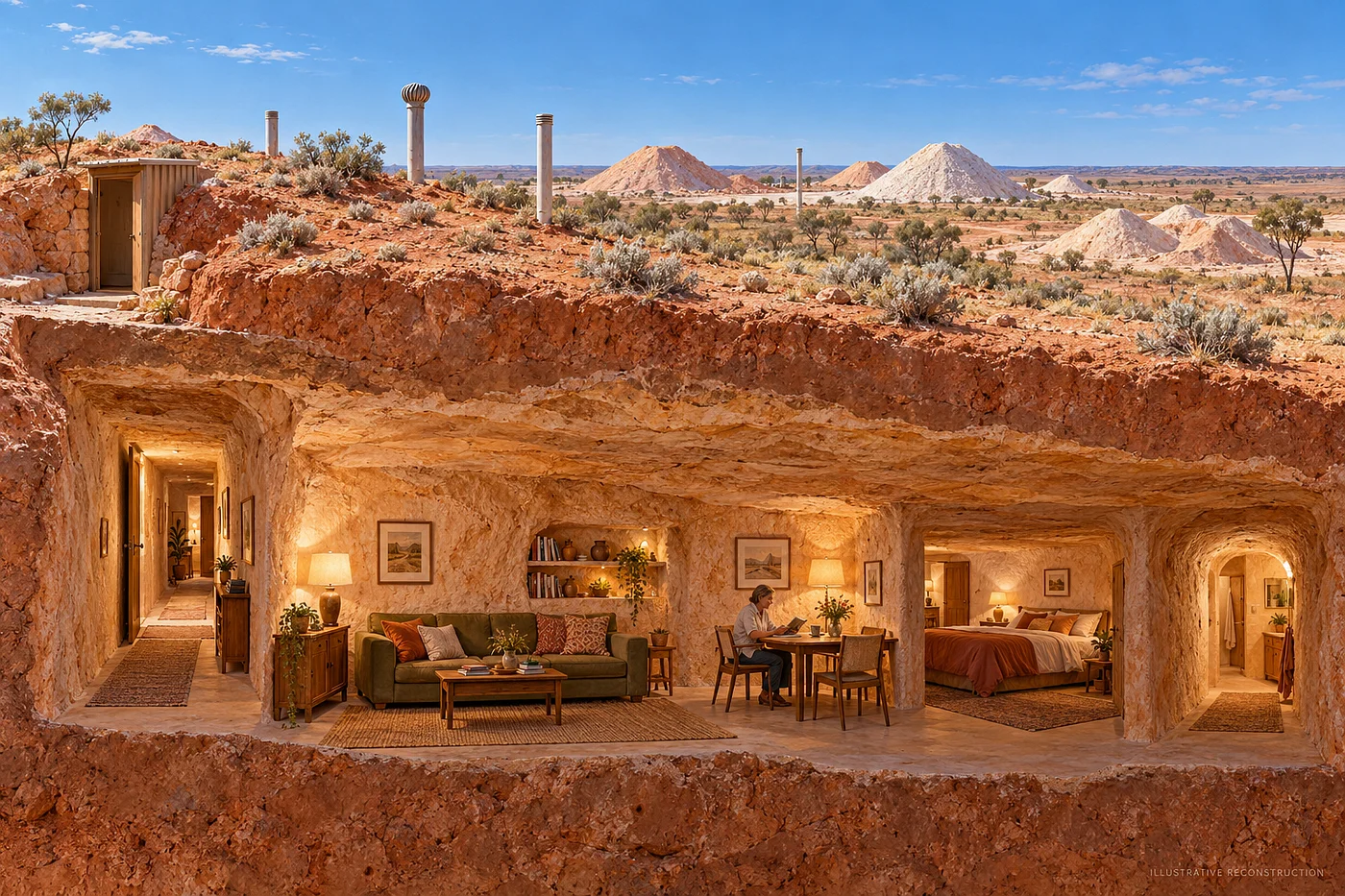
Why Coober Pedy Lives Underground
Why Coober Pedy Lives Underground
COOBER PEDY · SOUTH AUSTRALIA
In Coober Pedy, buying the house next door can mean tunnelling through to it.
Local tourism records describe families joining neighbouring dugouts to create larger underground homes. Elsewhere, extending the living room involves a builder. Here, excavation enters the conversation. (cooberpedy.com)
Welcome to Coober Pedy, South Australia, where opal mining and a demanding desert climate helped put homes, hotel rooms and churches beneath the surface.
They came for the opals
The mining town’s story began in 1915, when young Willie Hutchison found opal while accompanying a prospecting party. The discovery helped establish the settlement that became famous as Australia’s opal capital. (abc.net.au)
The attraction was underground.
As miners discovered, so was a considerably more comfortable place to live.
Summer heat and cold desert nights made shelter a serious consideration. Excavating into the hillside offered protection from both, and the skills of an opal-mining community were particularly useful when the next job was making a bedroom. (cooberpedy.com)
How Coober Pedy’s underground homes work
These homes are known as dugouts. Most are excavated horizontally into hillsides, rather than reached by descending a mine shaft.
The surrounding earth buffers temperature changes. Coober Pedy’s visitor information describes underground rooms remaining around 23–25°C, although conditions vary between properties.
Inside, the unfamiliar part is the rock surrounding otherwise familiar domestic life: bedrooms, living areas and space for the furniture.
Some larger dugouts extend across hundreds of square metres. Underground does not necessarily mean cramped. It can mean you have lost track of which direction the guest bedroom goes. (cooberpedy.com)
Even the churches went underground
Once you can carve out a comfortable home, the idea has other applications.
Coober Pedy’s underground churches include St Peter and Paul Catholic Church, which opened in 1967, and the Serbian Orthodox Church of Saint Elijah the Prophet, built in 1993. Places of worship became part of the town’s distinctive underground architecture. (cooberpedy.com)
Visitors can sleep beneath the surface, too. Underground accommodation such as the Desert Cave Hotel turns the same practical response to the climate into a memorable overnight stay. The earth provides natural temperature moderation; the hotel supplies the bed. (southaustralia.com)
Rooms below
What makes Coober Pedy remarkable is how ordinary life continues inside an extraordinary setting.
People came looking for something valuable in the ground. They also found a way to make themselves comfortable there.
The result is a town where underground living belongs to daily life, local history and the visitor experience.
“Rooms below” is less a joke than a direction.
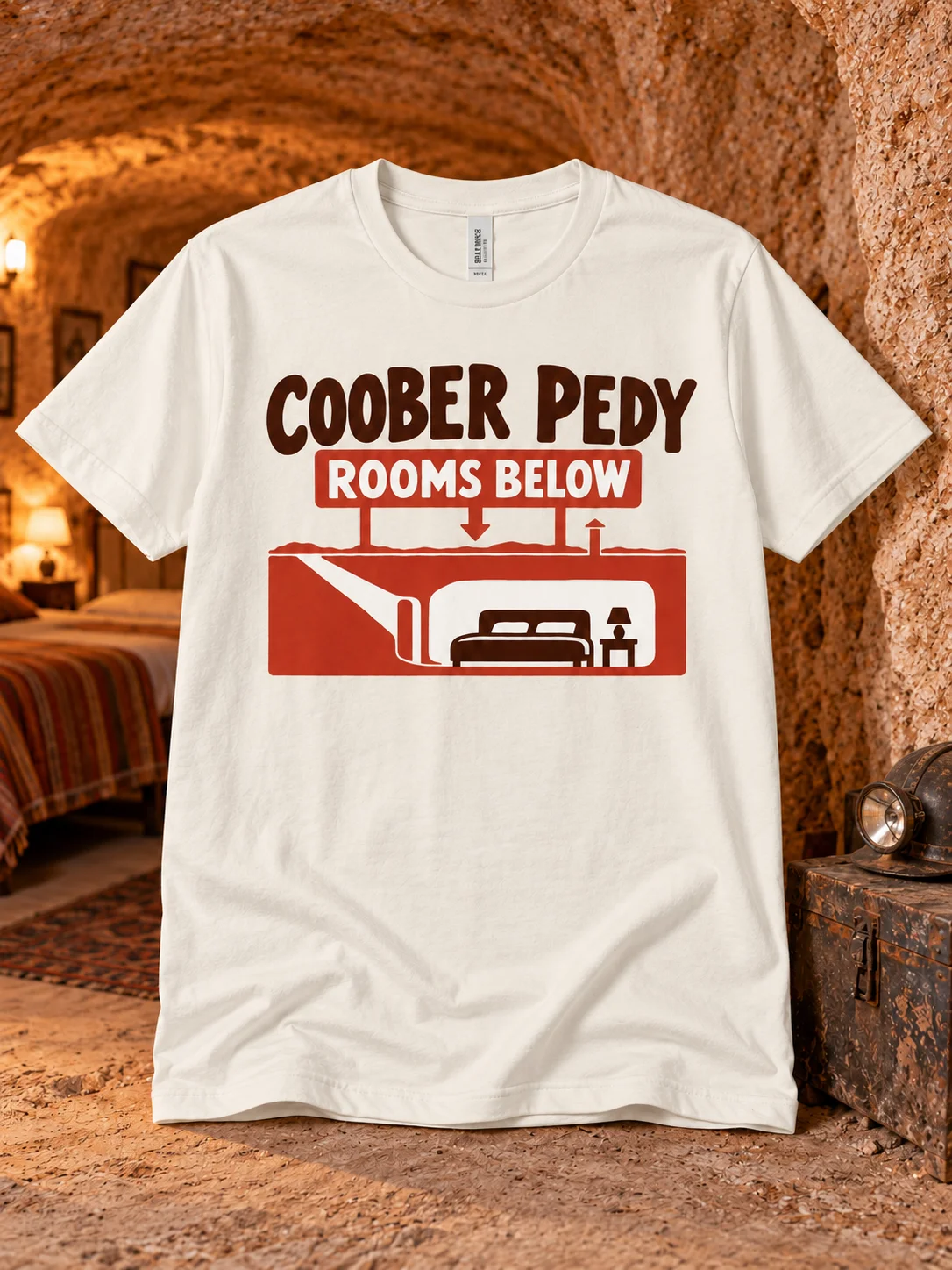
Coober Pedy Underground T-Shirt
Coober Pedy. Rooms Below.
In most towns, the best accommodation comes with a view. In Coober Pedy, it comes with several metres of earth overhead.
Deep in the South Australian outback, the opal-mining town of Coober Pedy has an unusual solution to the desert heat: go underground.
For generations, residents have lived in excavated homes known as dugouts, where the surrounding rock provides natural insulation from the scorching summer temperatures. The tradition has also given rise to underground hotels, motels and guest accommodation. Proper bedrooms, comfortable beds, and considerably less interest in what’s happening above ground.
Our Coober Pedy — Rooms Below T-shirt takes its inspiration from the town’s subterranean accommodation, with a bold roadside-style sign and a cutaway illustration revealing a furnished bedroom beneath the desert surface.
It’s an Australian travel souvenir for a destination where the accommodation is quite literally the attraction.
Perfect for:
- Coober Pedy visitors and South Australian outback travellers
- Fans of unusual destinations and Australian road trips
- Opal mining history and underground architecture enthusiasts
- Geography nerds and lovers of strange places
- Anyone looking for an unusual Australian travel souvenir or a gift for an adventurous traveller
Coober Pedy. Rooms Below.
The view from your room is probably sandstone.
Coober Pedy Underground T-Shirt Size Guide
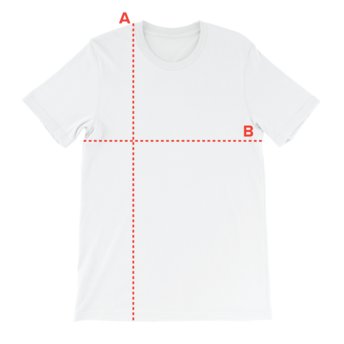
| Size label | Length | Width |
|---|---|---|
|
XS
|
27
|
16 1/2
|
|
S
|
28
|
18
|
|
M
|
29
|
20
|
|
L
|
30
|
22
|
|
XL
|
31
|
24
|
|
2XL
|
32
|
26
|
|
3XL
|
33
|
28
|
|
4XL
|
34
|
30
|
|
5XL
|
35
|
32
|